: In the land where mountains breathe and silence speaks, every footstep becomes a story.
The Himalaya does not reveal herself easily. She waits—silent, patient—allowing only those who move with respect, curiosity, and humility to enter her world. My journey began long before my boots touched the mountain trails of Nepal. It began with a longing to understand what lies behind the snow peaks that rise like sacred guardians across the northern sky.
When I finally set foot in the highlands, the air was thinner, but the world felt larger. Villages clung to cliffs like stubborn dreams. Rivers cut through stone with ancient determination. And above everything, the mountains watched, unmoving, eternal.
This is the story of my walk through those mountains—a journey of breath, struggle, kindness, and moments that carved themselves into memory like the ridgelines of the Himalaya.
The trail began in the warmth of lowland forests—bamboo bending gently, rhododendrons whispering in the wind. But as I climbed higher, the world changed. The forest thinned. The wind carried the distant call of ravens. The clouds moved differently, swirling low enough to touch the tips of pine trees.
I met an old shepherd along the way. His face was a map of valleys and years.
“Up there,” he said, pointing toward the distant ridges, “the mountains listen. Walk softly.”
His words stayed with me.
As the path twisted upward, each step demanded breath, strength, and patience. My heartbeat seemed to echo through the entire valley. Yet, with every struggle came reward—glimpses of faraway peaks glowing like crystal towers in the sun.
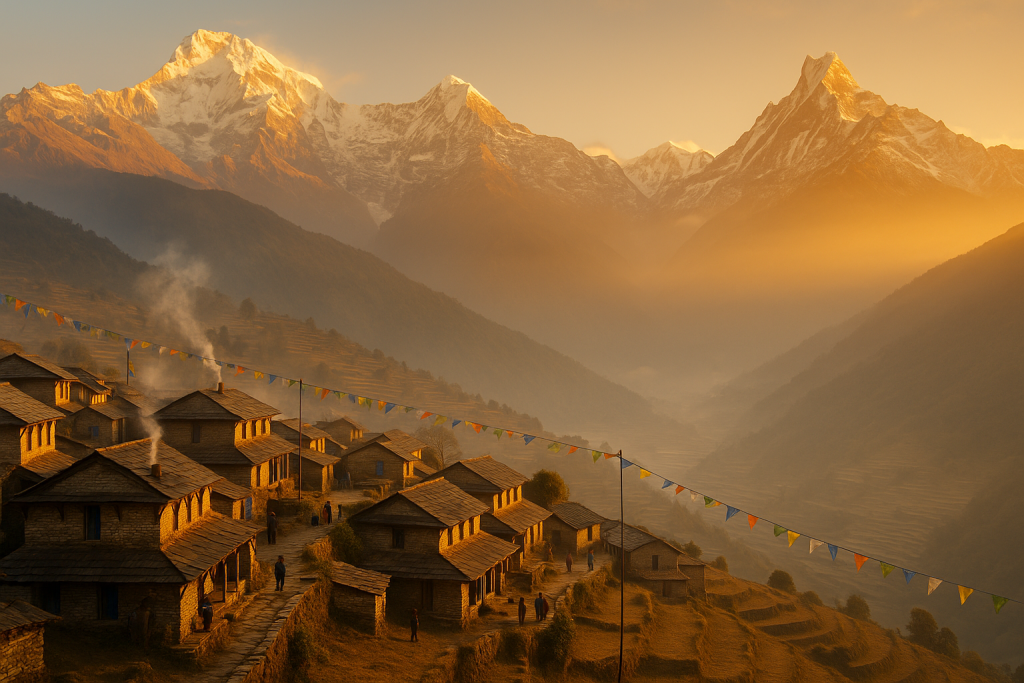
After hours of climbing, I reached a village perched so high that it felt closer to the clouds than the earth. Stone houses lined narrow pathways, smoke rising from wooden roofs as families prepared their evening meals. Children ran barefoot over cold stones, laughing as if the mountains themselves played with them.
Despite the chill in the air, the village felt warm—alive with stories.
That evening, I sat by the hearth of a Gurung family. Flames danced on the walls as the grandmother brewed butter tea. The grandfather, his voice deep and grounded, spoke of winters when the snow reached doorways, of festivals where villagers danced under full moons, and of soldiers who traveled far but never forgot their home.
“People think the Himalaya is only mountains,” he said. “But the Himalaya is people too.”
His words hung in the smoky air, warm and true.
Between Night and Dawn
Before dawn, the entire village slept under a blanket of silence. Only the wind moved, brushing against prayer flags that fluttered like the breath of the mountains.
I climbed a small ridge behind the village to watch the sunrise.
The world slowly shifted from darkness to a deep blue. The peaks stood like shadows—massive, still, ancient. Then the first beam of sunlight touched the highest summit. It was as if the mountain itself awoke, lighting up piece by piece.
Snow began to glow. The air shimmered. The whole landscape transformed into a painting of gold and ice.
In that moment, I understood why people call the Himalaya “Deviko desh”—the land of the gods.
As I continued my journey, the mountains became my companions. Their shapes changed with every turn, each peak carrying its own personality—stern, playful, mysterious, wild.
I passed yak caravans, their bells echoing across the valleys. I met monks walking barefoot to remote monasteries. I saw blue sheep grazing on impossible cliffs.
But the most unforgettable encounter was with a young girl shepherding her goats. She stood fearless on a rocky slope, wind tugging at her scarf.
“Are you not afraid?” I asked.
She smiled, shaking her head. “Why fear the mountains? They know us. We grow up under them.”
Her voice held a confidence stronger than the stone beneath my feet. It was then I realized—the Himalaya raises people with a different kind of courage.
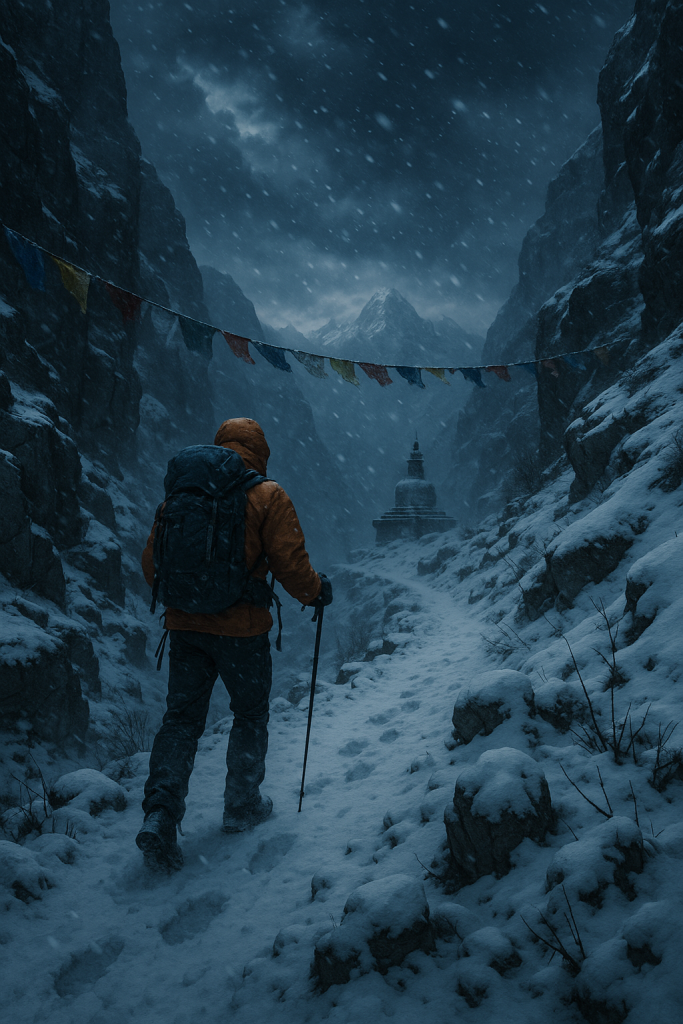
In the Himalaya, weather is a ruler with unpredictable moods. One moment the sky was clear and endless, and the next moment clouds gathered like a silent army. The wind sharpened. The trail grew darker.
Snowflakes began to fall—soft at first, melting on my gloves. Then heavier. Soon the world turned white, and the path disappeared beneath my feet.
For a moment, fear whispered at the back of my mind. But far ahead, through the swirling snow, I saw the dim outline of a chorten—a stone stupa built by travelers to guide others.
Step by step, I followed it. The mountains may be unforgiving, but they also leave signs for those who look carefully. Eventually, the snow thinned, and the sky cracked open once more, revealing a band of sunlight on the distant ridge.
Relief washed over me like a warm hand.
The Monastery Above the World
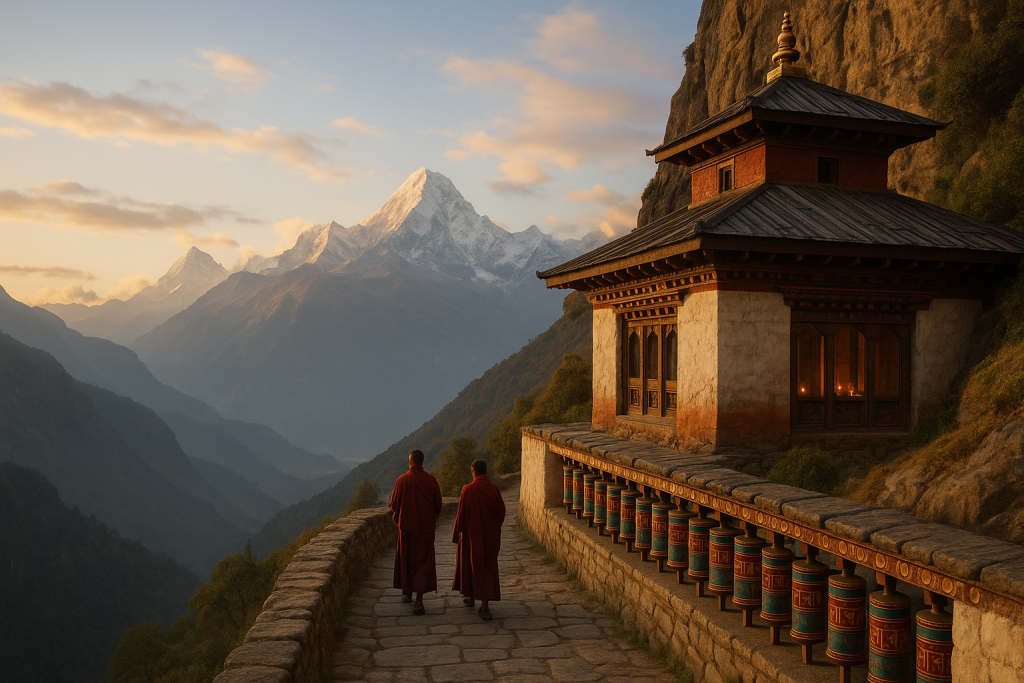
Higher still, I reached a monastery built on a ledge where the sky felt impossibly close. Prayer wheels lined the entrance, spinning gently in the mountain wind. A young monk greeted me with a humble smile.
Inside, butter lamps flickered, casting golden light on ancient statues. The air smelled of juniper and incense. The chanting of monks drifted softly through the courtyard—calm, rhythmic, eternal.
I asked the head monk what the mountains meant to him.
He closed his eyes and answered, “The mountains do not speak, but they teach. Whoever walks here learns who they truly are.”
It was the most perfect description of the Himalaya I had ever heard.
As the sun dipped low, the mountains turned shades of pink and purple. Smoke rose from distant villages. The sound of a river echoed from far below like the heartbeat of the earth.
Wrapped in a woolen blanket, I sat on a ridge watching the night arrive.
Stars appeared—slow at first, then in thousands. The Milky Way stretched across the sky like a glowing river, brighter than I had ever seen.
Everything felt vast. Beautiful. Infinite.
And for the first time in a long time, I felt small in the best possible way.
Conclusion – What the Himalaya Gave Me
When I finally descended back toward the lowlands, the world seemed different—not because the mountains had changed, but because I had.
The Himalaya taught me:
Patience, in the slow rise of trails
Strength, in the thin air of high altitudes
Humility, before peaks that have stood for ages
Connection, with strangers who felt like family
Silence, that speaks louder than words
Traveling through the Nepali Himalaya is not just a journey across landscapes—it is a journey through yourself.
The mountains do not ask for anything.
They simply invite you to listen.
And once you listen, you are never the same again